
US-Based Supplier No online checkout, every order starts with a quote We invoice through Stripe once stock and lead time are confirmed
Order Status
UV Spot Shop SPOT UV CURING SYSTEMS
Search
Compare Systems Request a Quote
Home Tech Support
Home Applications
PROCESS GUIDES · SPOT UV CURING

Application Notes

Three proven spot-curing processes from the assembly lines we supply every week. Each note covers the production problem, the spot-curing approach, a typical process sequence, working parameters, and a recommended setup you can order today.

PCB & Tacking Bonding & Potting Medical & Optical
APPLICATION NOTE 01 · ELECTRONICS ASSEMBLY

PCB & Component Tacking

Wire tacking · connector staking · coil termination, on populated boards, without masking or thermal cycling
The challenge

Populated boards leave no room for process heat. A hand-soldered jumper or fine magnet wire on a transformer bobbin will shift during depaneling, conformal coating, and test unless it’s staked, but a 30-minute oven pass to cure a staking epoxy thermal-cycles every joint on the assembly, and masking for a selective process adds labor without fixing the underlying problem. Connectors and tall electrolytics that see board flex need reinforcement at exactly one point, not a bulk cure of the whole board.

The spot-curing approach

A spot cure puts energy only where the adhesive is. Dispense a small dot of UV acrylate over the wire, connector shoulder, or coil termination, bring a 3–8 mm spot onto it, and the dot reaches handling strength in one to four seconds while neighboring components stay at ambient. On automated lines, a 4-channel LED controller like the SkyBeam stakes four points per index with PLC handshaking; for benchtop work and short runs, the broad-spectrum SunSpot 2 covers any staking chemistry, including older broadband-cure formulations.

TYPICAL PROCESS
01
Dispense
Apply 1–3 mm dots of a low-shrink UV acrylate to each wire, connector shoulder, or coil termination.
02
Position
Fixture the light guide 8–12 mm above the joint for a 5 mm spot, up to four joints at once on a 4-channel setup.
03
Expose
Trigger a timed 1–4 s burst per joint. The board never sees bulk heat, no reflow risk, no warp.
04
Verify
Spot-check dose weekly with a radiometer and pull-test the first article each shift.
TYPICAL PARAMETERS Wavelength: 365–405 nm Spot size: 3–8 mm Exposure: 1–4 s Throughput: up to 4 joints / cycle
Recommended setup
Ships from stock in 24–48 hrs
SkyBeam 4-channel LED controller
P/N UV3979 · 365/385/395/405 nm heads · PLC I/O & RS-232 for the line. Benchtop instead? The SunSpot 2 covers broad-spectrum chemistries.
SYSTEM
Adhesive selection. Pick a low-shrinkage acrylate rated for tacking and staking, high-shrink chemistries can lift fine-pitch pads or stress solder joints as they cure. Your adhesive datasheet lists the required wavelength and dose; we’ll match the source to it.
Dose verification. Output drifts as lamps and guides age. Measure intensity at the guide tip with a UVA radiometer on a fixed schedule and log it, a 20% drop means it’s time to service the guide or swap the lamp.
APPLICATION NOTE 02 · STRUCTURAL BONDING & ENCAPSULATION

Adhesive Bonding & Potting

Structural bonds on glass, metal & engineering plastics · dam-and-fill encapsulation of sensors and dies
The challenge

Structural bonds between glass, metal, and engineering plastics rarely tolerate the clamps-and-oven cycle of a heat-cure epoxy: fixtures tie up work-in-progress for hours, dissimilar-material joints build stress as they cool, and throughput is capped by rack space. Encapsulating a sensor or bare die by dam-and-fill raises a second problem, the fill has to cure through millimeters of depth without cooking the part underneath, and any adhesive the light can’t reach stays wet.

The spot-curing approach

UV spot curing fixtures the part for seconds instead of hours. The SunSpot 2’s 200 W arc delivers >18 W/cm² of UVA plus UVB and visible content across 275–650 nm, that broad spectrum penetrates thick encapsulant sections and fully cures surface-inhibited and dual-cure chemistries that single-wavelength LEDs leave tacky. One lamp splits across up to four light-guide poles, so a four-point bond line or a full dam-and-fill perimeter cures in a single timed exposure.

TYPICAL PROCESS
01
Prep
Solvent-wipe both substrates; abrade or plasma-treat low-energy plastics for reliable adhesion.
02
Dispense
Lay the structural bead, or dispense the dam, gel it with a short exposure, then fill the encapsulant.
03
Cure
Expose 2–10 s per zone. Broad-spectrum output drives cure deep and eliminates surface tack.
04
Inspect
Shear-test first articles; fluorescing adhesives make coverage checks a two-second UV-lamp look.
TYPICAL PARAMETERS Wavelength: broad 275–650 nm Spot size: 5–12 mm Exposure: 2–10 s Throughput: up to 4 zones / lamp Depth of cure: to ~5 mm
Recommended setup
Ships from stock in 24–48 hrs
SunSpot 2, 200 W broad-spectrum arc
P/N UV1853 (120 VAC) / UV2132 (240 VAC) · >18 W/cm² UVA · integral timer & shutter
SYSTEM
Spare UV1866 lamp module
Quick-change 200 W cartridge on the shelf keeps a production cell running at lamp end-of-life
SPARES
Fixturing. UV cures are line-of-sight. Design dams and fixtures so the guide tip sees every fillet, shadowed adhesive stays wet. Angle two poles at opposing 45° positions to reach around vertical walls.
Deep sections. For pots deeper than ~5 mm, fill and cure in two passes or specify a dual-cure (UV + moisture or heat) chemistry, and verify the final dose at depth with a radiometer during qualification.
APPLICATION NOTE 03 · MEDICAL DEVICE & PHOTONICS

Medical & Optical Assembly

Needle bonding · catheter assembly · lens fixing · fiber termination, with validated, repeatable dose control
The challenge

Needle bonding, catheter tipping, lens fixing, and fiber termination all share one constraint: the process must be validated once and then repeated, exactly, thousands of times. Operator-held lamps introduce dose variability that no quality system can paper over, hot filament sources add infrared that shifts optical alignment as the joint warms, and an undocumented cure is an audit finding waiting to happen.

The spot-curing approach

An LED spot system makes dose a programmed, logged parameter instead of an operator skill. Each of the SkyBeam’s four channels holds its own wavelength head (365 nm is the workhorse for medical-grade adhesives), intensity setting, and exposure timer, store the recipe and every part sees the same energy, up to 11,000 mW/cm² with virtually no IR heating. Per-channel LED life logs plus routine radiometer checks close the loop for ISO-style process validation, and RS-232/PLC I/O ties the cure record into your line controller.
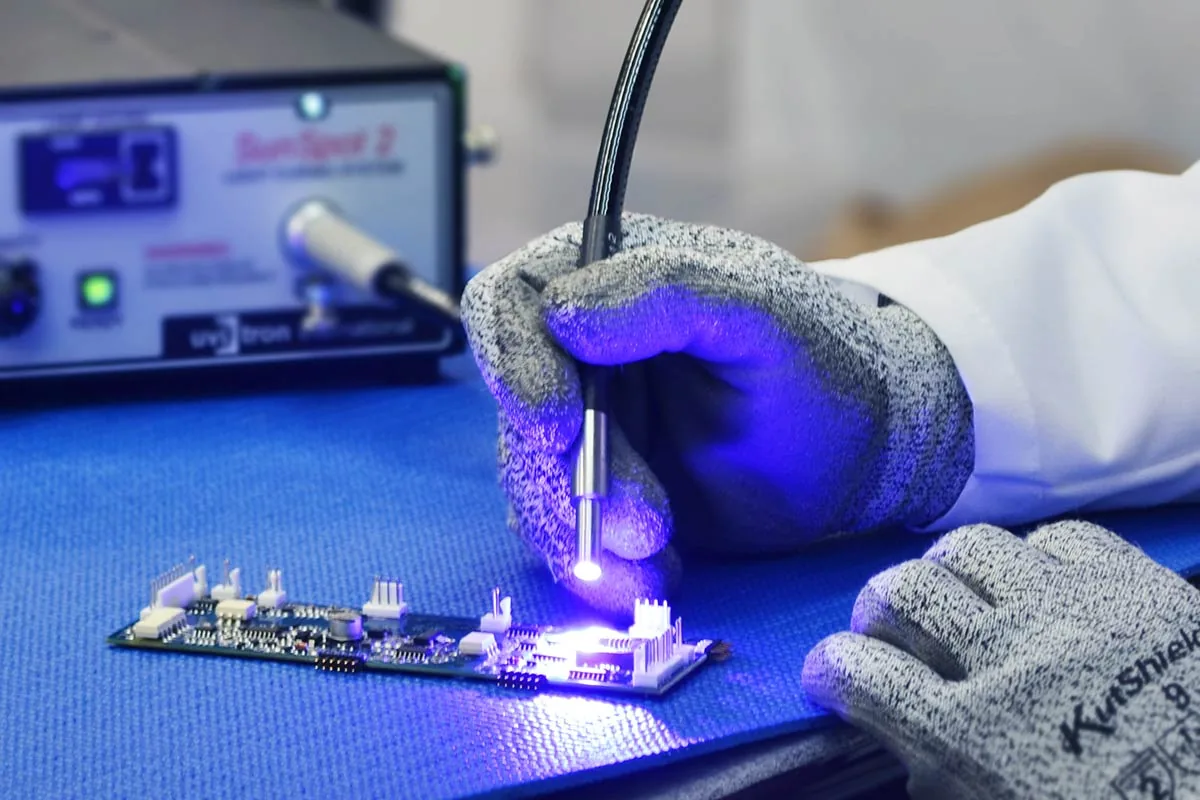
Spot cure in progress on a benchtop assembly
On the bench: a 5 mm spot delivers a timed, radiometer-verified dose to a single bond point.
TYPICAL PROCESS
01
Fixture & dispense
Locate the needle, lens, or ferrule in the fixture and dispense a controlled adhesive volume.
02
Program
Set the channel’s wavelength, intensity, and exposure time, then store it as the validated recipe.
03
Expose
Cure up to four bond points simultaneously, each on its own timer, 1–5 s per joint, no IR heat.
04
Log & verify
Record radiometer readings against the validated dose window; channel life logs track LED output over time.
TYPICAL PARAMETERS Wavelength: 365 nm (385–405 optional) Spot size: 2–5 mm Exposure: 1–5 s Throughput: 4 stations / controller
Recommended setup
Ships from stock in 24–48 hrs
SkyBeam 4-channel LED controller
P/N UV3979 · per-channel timers & life logs · RS-232, PLC I/O and safety interlock · 20,000 hr LEDs
SYSTEM
Validate a window, not a number. Establish minimum and maximum dose during qualification, then verify daily with a radiometer traceable to your quality system. Adhesives with a fluorescing agent make 100% visual inspection practical.
Rework & oversize parts. For field repair or assemblies that won’t fit a fixture, the handheld SkyWand cures the same 365/405 nm chemistries cordlessly, with constant output that won’t fade on a low battery.

Spec it right the first time

Tell us your adhesive, substrate, and cycle time. Our US-based application engineers will recommend the exact system, light guide, and accessories for your process, with a written quote back within one business day.


US-based application engineers Response within 1 business day Systems ship in 24–48 hrs
Request a Quote Talk to an Engineer
Still deciding on a system?
Talk to a US-based application engineer, we'll match the system to your adhesive.
Request a Quote
UV Spot Shop
Spot UV curing systems for electronics, medical, and optical assembly. In stock and shipping from the US.
Stay in the loop
Subscribe
No spam. Unsubscribe anytime.
© 2026 UV Spot Shop · All rights reserved Powered by Stripe